In the current economic landscape, "operational efficiency" has transitioned from a buzzword to a core survival mechanism. For facility and property managers, the most significant lever for financial optimization is the work order. No longer just a digital task-tracker, the modern work order is a strategic data asset. When paired with Artificial Intelligence, it is currently slashing maintenance overhead by double digits across the globe.
As we move through 2026, the shift from reactive to intelligent maintenance is backed by a growing body of empirical evidence. Here is the data-driven case for modernizing your work order workflow and the specific benchmarks defining the industry today.
The Global Surge in AI Adoption for Facilities
The "wait and see" period for AI in property management is officially over. Organizations that failed to digitize their work order systems are now finding themselves at a significant competitive disadvantage.Recent industry reports indicate that 88% of organizations have now integrated AI into at least one core business function- a massive jump from just 55% in 2023. Within the niche of physical operations, the numbers are even more specific. Roughly 22% of facility-heavy businesses have fully automated their triage and dispatching through generative AI, ensuring the right technician reaches the right asset without a single human phone call being made.
This surge is driving the work order management software market toward a projected valuation of $1.41 billion by 2031. The growth isn't just in "tracking" tasks; it is concentrated in advanced reporting and analytics modules as managers demand "predictive" rather than "historical" data.
The Staggering Cost of Reactive Maintenance
To understand the value of an intelligent platform like Work Order, one must first quantify the "Cost of Doing Nothing." The financial drain of traditional, manual maintenance is often hidden in unplanned downtime and administrative friction.The Emergency Premium
Data shows that emergency repairs are typically 3 to 5 times more expensive than planned maintenance. When a work order is generated reactively- after a total system failure- you aren't just paying for the repair; you are paying a premium for speed, after-hours labor, and expedited shipping for parts.
The Downtime Deficit
For industrial and manufacturing facilities, the stakes are even higher. The cost of unplanned downtime is now estimated at an average of $50,000 per hour. However, continuous monitoring and intelligent work order tracking can predict roughly 70% of asset failures at least 30 days in advance. This allows repairs to be moved from "emergency status" to "scheduled maintenance," occurring during standard business hours at standard labor rates.
Administrative Friction
In traditional setups, up to 30% of project effort is consumed by data reconciliation. This is the "hidden cost" of technicians and managers manually moving data between spreadsheets, paper logs, and email threads because their work order system doesn't integrate with their financial or parts-tracking software.
Proven ROI Benchmarks for AI-Driven Systems
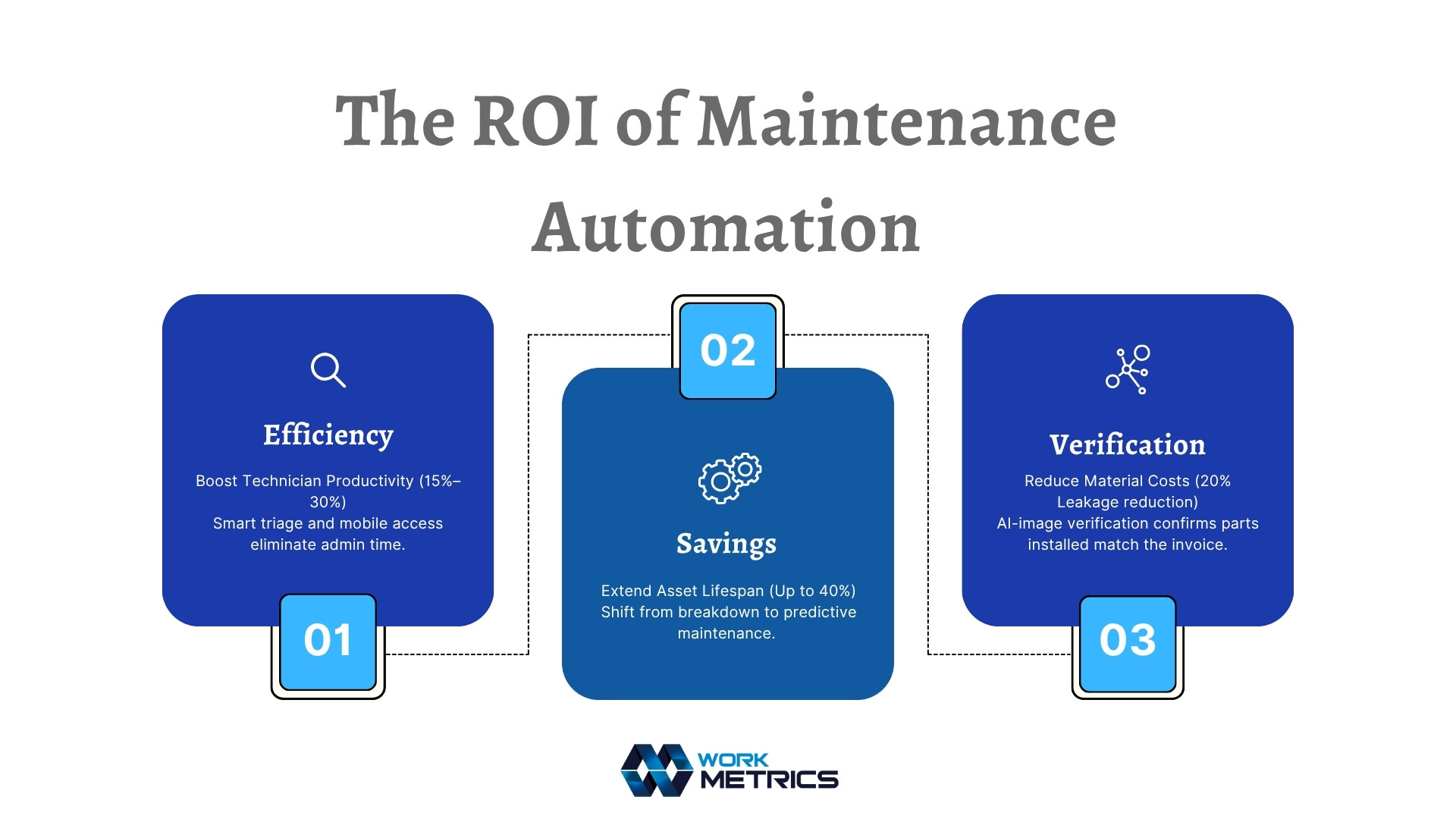 The transition to an AI-enhanced work order system delivers a measurable return on investment (ROI) that typically manifests within the first two fiscal quarters.
- Reduction in Total Maintenance Spend: Organizations typically see a 25% to 30% decrease in overall expenditure as "leakage" and emergency calls are eliminated.
- Extension of Asset Lifespan: Intelligent tracking and timely preventative maintenance can extend the life of high-value HVAC and mechanical systems by up to 40%.
- Productivity Gains: By automating the administrative side of the work order, technician productivity typically increases by 15% to 30%, as they spend less time on paperwork and more time on the tools.
- Downtime Mitigation: AI-driven predictive maintenance models have been shown to reduce total asset downtime by 35% to 75% depending on the age of the facility.
Beyond the Numbers: The Verification Revolution
The modern work order acts as an automated auditor, solving the age-old problem of "Trust vs. Verification" in contractor management.Eliminating the Callback
Callbacks are a profit-killer. Organizations utilizing AI-driven job completion checklists and real-time photo verification have reported a 40% reduction in callbacks. When a technician has the asset's full history and AI-guided diagnostics in the palm of their hand via a mobile work order, the "first-time fix" rate becomes the standard, not the exception.
Material Verification and Leakage
One of the most immediate ROI drivers is the reduction in material overpayments. AI-powered image recognition can now verify photos of installed parts against the submitted invoice. In sectors like automotive and heavy manufacturing, this level of oversight has led to a 20% reduction in maintenance costs by ensuring that the "premium" parts billed were actually the parts installed.
Looking Toward 2030: The Self-Healing Building
We are rapidly moving toward a model where the building manages itself. Financial analysts at Morgan Stanley estimate that by 2030, 37% of all tasks across property operations and maintenance will be fully automated.The organizations that will thrive are those that stop viewing the work order as a simple "to-do list" and start viewing it as a strategic data point. By capturing clean, AI-ready data today through platforms like Work Order, you are building the foundation for predictive models that will eventually eliminate the concept of "emergencies" altogether.
The data is clear: the gap between industry leaders and laggards is now defined by the sophistication of their tech stack. With a typical payback period of just 6 to 9 months for advanced maintenance platforms, the risk is no longer in the technology- the risk is in the cost of staying manual.